Signed in as:
filler@godaddy.com

The Great Material Disconnect
Global trade relies on Ultra-Large Container Vessels to move goods, yet these high-velocity pipelines stall at outdated seaports. While logistics technology has evolved, marine terminals remain frozen in the 1960s, stacking containers up to six high in open-air yards. This Last-In-First-Out (LIFO) model forces slow gantry cranes into wasteful "digging" shuffles to retrieve buried freight. This friction causes massive truck idling, exposes cargo to harsh weather, increases energy use, and strains power grids.
Adapting Retail Logistics to Heavy Freight
The solution requires adapting Fortune 50 retail systems—like those of Amazon and Walmart—to maritime trade. Retail networks eliminated LIFO bottlenecks by using automated high-bay racks where every item is individually accessible. By treating containers as heavy industrial pallets and storing them in an indoor Rack-Supported Building Automated Storage and Retrieval System (AS/RS), terminals give every container direct random-access addressability. Structural frame pins bear the load, completely eliminating rehandling shuffles.
A Vision for 2050
Transitioning to the Seaport Execution System yields a +66.2% increase in container velocity, 100% elimination of rehandling shuffles, a 75.0% smaller land footprint, a 57.2% cut in energy use, and a 75.3% reduction in carbon emissions—delivering an empirically verified blueprint for continuous, zero-emission flow.
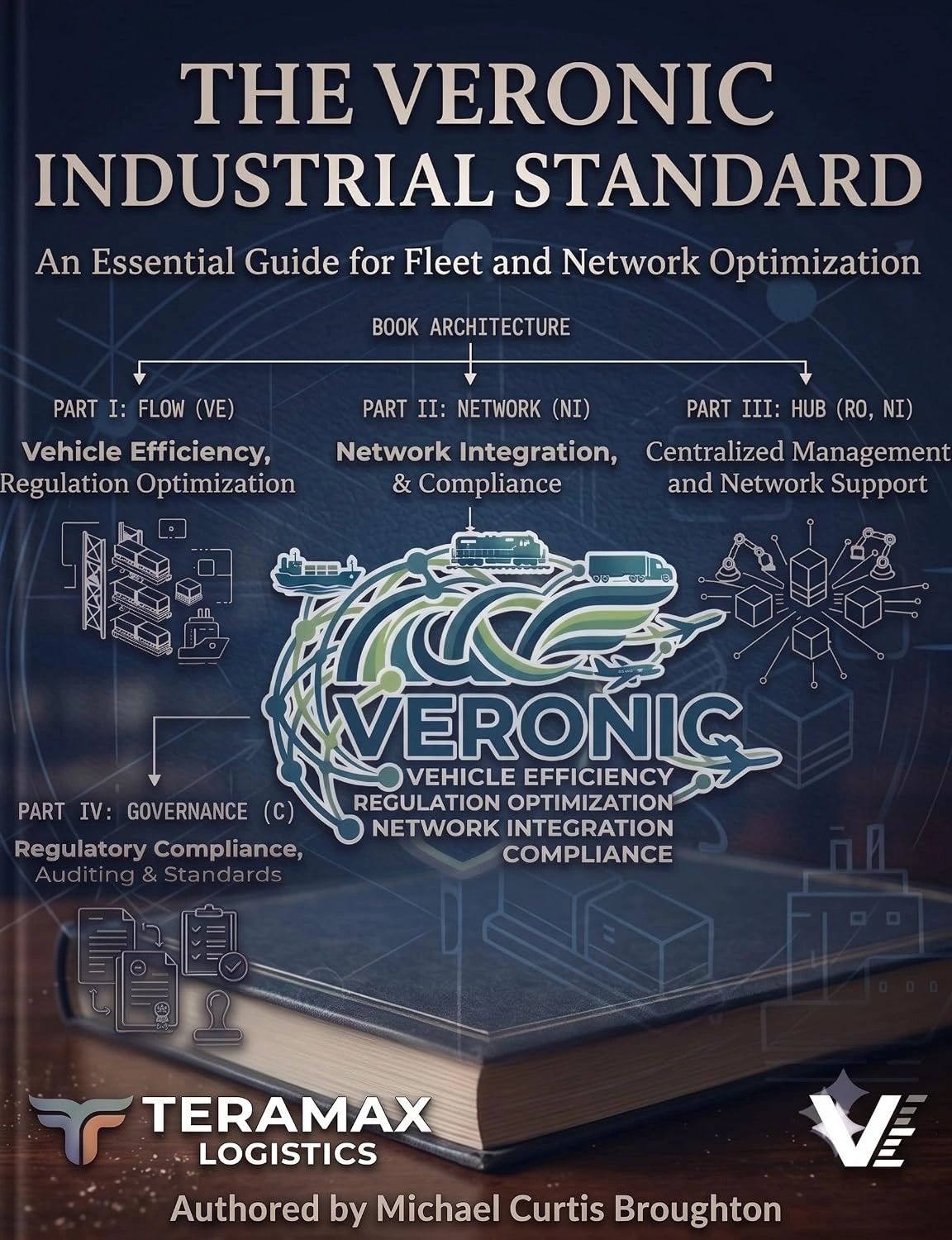
Global freight is one of the most capable systems ever built. Every day, ships, aircraft, railroads, and trucks move the materials of industry and daily life across oceans, continents, and communities.
This essential system is deeply fragmented. A shipment passes through multiple vehicles, terminals, operators, customs authorities, energy systems, and digital platforms. While each participant may perform competently in its own domain, the overall journey remains slow, costly, and unpredictable. Vessels arrive to unprepared berths, trucks wait in gate queues, containers idle for unavailable rail capacity, sensitive cargo sits exposed on ramps, electric fleets find inadequate charging power, and shipments stall at borders due to retroactive compliance paperwork. These are coordination failures between assets, facilities, networks, and regulatory boundaries.
This book argues that freight must be understood as a connected, cyber-physical flow system. The VERONIC Industrial Standard provides a common operating logic without requiring identical assets, uniform facilities, a single software platform, or centralized control. Participants retain their own design, ownership, and function, but share the ability to communicate operational facts for safe, reliable execution. They must declare intent, publish verified state, confirm compatibility, reserve real capacity, authorize movement, verify outcomes, ensure continuous compliance, manage exceptions, and release trusted data to the next handoff. VERONIC organizes this logic into four connected pillars:
Vehicle Efficiency (VE): Transforms moving assets into connected flow assets that preserve cargo condition, manage thermal metabolism, communicate readiness, connect safely to infrastructure, and recover predictably. Global Green Logistics (GGL) emerges here.
Regulation Optimization (RO): Governs the hub by converting plans into safe execution via time-bounded authorization, state-machine logic, multi-sensor verification, independent safety systems, and clear human authority
Network Integration (NI): Coordinates the wider system, aligning capacity, energy, routing, recovery, digital twin simulations, and commitments across distributed hubs and corridors.
Compliance (C): Embeds governance directly into physical execution, turning regulatory, customs, and environmental rules into active algorithmic gating constraints—delivering pre-clearance velocity, touchless borders, sensor-verified ESG accounting, and immutable chains of custody.
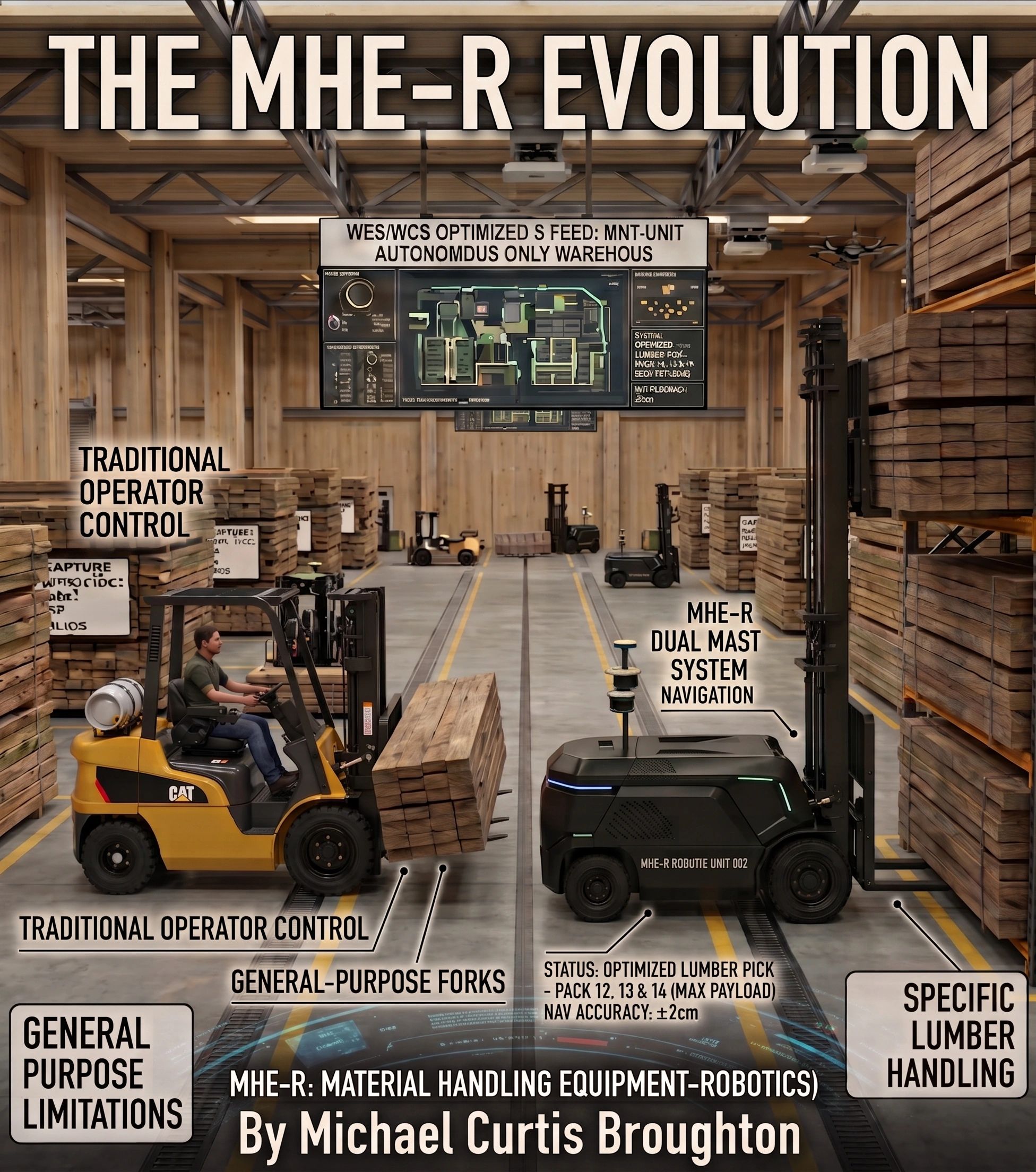
Coined by Michael Curtis Broughton, the MHE-R (Material Handling Equipment-Robotics) Revolution replaces traditional human-operated machinery with driverless robotic units to move heavy, non-palletized goods like lumber and appliances. Paired with Warehouse Execution Systems (WES) and Warehouse Control Systems (WCS), this automation streamlines inventory placement, eliminates distribution bottlenecks, and boosts capital efficiency across large retail logistics networks.
Broughton’s 2024 Master’s thesis at Northern Illinois University (NIU), "Large Retail Logistics Warehouse Execution System," provides the empirical framework for this technology. Supervised by Dr. Reinaldo Moraga, his research shows that replacing standard warehouse management practices with an integrated WES/WCS model yields direct financial gains—including up to a 90% reduction in labor-related operating costs—while advancing supply chain flexibility and eco-friendly warehousing.
Modernizing traditional retail distribution center business processes through autonomous robotics.
Seamlessly orchestrating Stock, Store, and Ship functions under a unified software hub.
Transforming raw facility productivity into measurable corporate financial performance.
In The News!
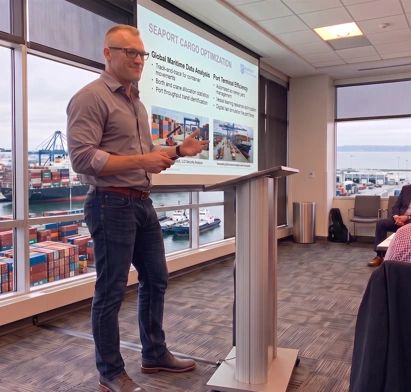
Logistics Expert and Scholar Michael Curtis Broughton Publishes New Book THE SEAPORT EXECUTION SYSTEM.
In The News!
HOUSTON, Aug. 19, 2026 (GLOBE NEWSWIRE) -- Retired U.S. Army Captain, industrial engineer, and logistics innovator Michael Curtis Broughton has published The VERONIC Industrial Standard: An Essential Guide for Fleet and Network Optimization.